Book · 2021
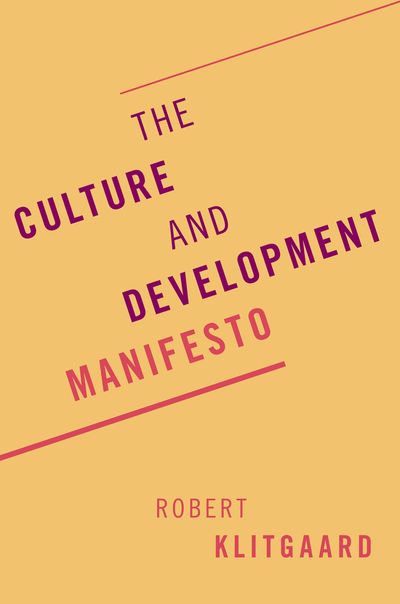
The Culture and Development Manifesto
A landmark argument for bringing cultural knowledge into development economics — with examples from Nepal to South Sudan, Senegal to the Philippines.
PublisherOxford University Press
Year2021
About this book
Gently but firmly, Robert Klitgaard shows how and why anthropology and cultural studies have fallen short in application–and, arguably, in terms of social science. And yet, these fields have much to offer, as he demonstrates through lively examples ranging from Nepal to South Sudan, from Senegal to the Philippines, from Niger and Equatorial Guinea to Indonesia.
Anthropology can provide distinctive information and compelling descriptions, case studies of successful adaptation and resistance, deconstructions of poisonous cultural texts, useful checklists, and processes for combining outside expertise and local knowledge.
The Culture and Development Manifesto has the goal of mobilizing knowledge from and for the disadvantaged, the indigenous, and the voiceless, always respecting their sovereignty. It is also aimed at economists and policymakers: policy research and evaluation should not aim at deriving “solutions” but at enabling creative and collaborative problem solving. This book explains why and how.
Praise
“In this highly engaging book, Klitgaard not only brings economics and culture into dialog with each other, he goes beyond ‘culture matters’ to demonstrate what ‘taking culture into account’ may mean in practice. This is a book that only Klitgaard, with his sharp multidisciplinary lens, wealth of on-the-ground experience, and remarkable penmanship, could have pulled off.”
Dani Rodrik, Ford Foundation Professor of International Political Economy, Harvard Kennedy School
“This book seeks to open a path between two disciplines that often seem hermetically sealed — cultural anthropology and development economics. It will be of immense use to any practitioner working at this highly fraught boundary.”
Francis Fukuyama, Stanford University
“A brilliant plea, subtly combining scholarship, examples, and common sense, to mobilize the competencies of anthropologists for a better adaptation of development policies to local conditions.”
Jean-Pierre Olivier de Sardan, École des Hautes Études en Sciences Sociales
Topics
Culture, Development, Anthropology, Economics, Policy
Related
Related themes: Culture & Development | International Development
Related books: Adjusting to Reality | Tropical Gangsters | Corrupt Cities[Links to related articles, talks, or theme pages]