The Culture and Development Manifesto
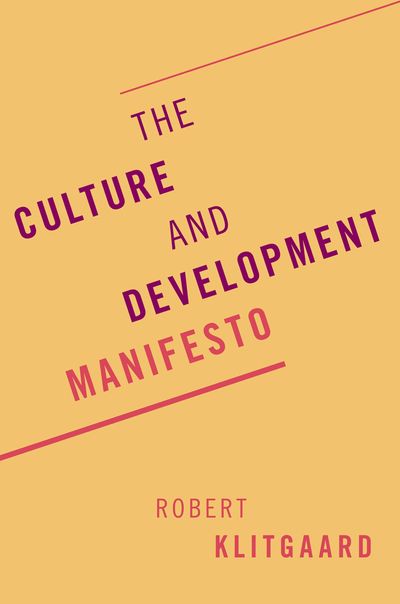
Oxford University Press, 2021
Gently but firmly, Robert Klitgaard shows how and why anthropology and cultural studies have fallen short in application--and, arguably, in terms of social science. And yet, these fields have much to offer, as he demonstrates through lively examples ranging from Nepal to South Sudan, from Senegal to the Philippines, from Niger and Equatorial Guinea to Indonesia.
Anthropology can provide distinctive information and compelling descriptions, case studies of successful adaptation and resistance, deconstructions of poisonous cultural texts, useful checklists, and processes for combining outside expertise and local knowledge.
The Culture and Development Manifesto has the goal of mobilizing knowledge from and for the disadvantaged, the indigenous, and the voiceless, always respecting their sovereignty. It is also aimed at economists and policymakers: policy research and evaluation should not aim at deriving "solutions" but at enabling creative and collaborative problem solving. This book explains why and how.
Praise for The Culture and Development Manifesto
“In this highly engaging book, Klitgaard not only brings economics and culture into dialog with each other, he goes beyond ‘culture matters’ to demonstrate what ‘taking culture into account’ may mean in practice. This is a book that only Klitgaard, with his sharp multidisciplinary lens, wealth of on-the-ground experience, and remarkable penmanship, could have pulled off.”
—Dani Rodrik, Ford Foundation Professor of International Political Economy, Harvard Kennedy School
"The Culture and Development Manifesto seeks to open a path between two disciplines that often seem hermetically sealed, cultural anthropology and development economics. It will be of immense use to any practitioner working at this highly fraught boundary.”
—Francis Fukuyama, Stanford University
"This book is a brilliant plea, subtly combining scholarship, examples, and common sense, to mobilize the competencies of anthropologists for a better adaptation of development policies to local conditions. It is based on a robust premise: in the confrontation between the interventions of development agencies and the social contexts in which they are implemented (local cultures), the many failures do not stem from a refusal of development by the populations but from an incapacity of public policy experts to take local cultures into account. The final proposal—convening dialogues between experts, anthropologists, and local actors—is highly stimulating."
—Jean-Pierre Olivier de Sardan, École des Hautes Études en Sciences Sociales, Marseilles, and LASDEL, Niamey, Niger; author of Anthropology and Development.
“As anthropologists and management consultants know, sometimes it takes an outsider to show the value of an idea. In this provocative and thoughtful book, Klitgaard shows that it may take an outsider (an economist, no less) to show how the study of culture holds practical lessons for human development. Rather than seeing ‘culture’ as an obstacle to development and wellbeing, he shows how both creativity and collaboration emerge from bringing together on equal footing different, even competing, beliefs and ways of looking at the world. Connecting the dots between theory and policy, he offers a practical and useful ‘convening framework’ to operationalize this model. Policy makers as well as scholars and practitioners of development should read this book and work to implement its conclusions.”
—Edward F. Fischer, Cornelius Vanderbilt Professor of Anthropology and Director of the Center for Latin American Studies, Vanderbilt University eal.
"A proposition universally accepted, it seems, is that culture should (must) be taken into account in international development work. However, there is zero consensus as to how best to do so. Worse, the pitfalls on the path to integrating cultural approaches make many duck and avoid the topic altogether. Bob Klitgaard has grappled with this dilemma for many years, on the ground and in the academy. In The Culture and Development Manifesto, he sets out the challenges and their historic evolution with lucid clarity (and a host of stories), and offers some sensible, if demanding, ways forward. "
—Katherine Marshall, Georgetown University and Executive Director of the World Faiths Development Dialogue; author of Development and Faith.
Review in the Journal of Development Studies
Few other accomplished academic authors write as boldly or bravely as Robert Klitgaard, or with style as crisp and trenchant. A book by him on a topic as important as what cultural anthropology and development economics ought to learn from each other is bound to attract skeptical attention from either end. He anticipates this in his opening lines: ‘Are you sure you want that title? In some academic circles, both “culture” and “development” are dirty words. And manifesto?’ But damn the torpedoes, Klitgaard seems to say; onward toward a patient, pragmatic rapprochement.
A University Professor at Claremont Graduate University, Klitgaard, an economist with public policy training, has taken unusual care to read up, and read back, in cultural anthropology too – at least a century of its theories and ethnographies. He has conducted extensive fieldwork in Africa, particularly in Equatorial Guinea and South Africa, and elsewhere.
‘Mainstream’ (neo-classical) economics and cultural anthropology are two (sub)disciplines long known to be mutually skeptical, even dismissive. True, anthropologists had a ‘formalist’ (quantitative-leaning) and a ‘substantivist’ (cultural relativist, holistic) side a half century ago. True, journals like Economic Anthropology and the multidisciplinary Journal of Cultural Economy are making steady strides. And true too, some economists, inspired by psychologists Daniel Kahneman and Amos Tversky, have come to accept, in behavioral economics, that humans don’t always just think ‘rationally’ or selfishly seek profit. Others, meanwhile, since the advent of the once ‘new institutional economics’, have tested game theories experimentally in steaming rainforest or icy tundra, to see if familiar ‘western’ assumptions – say, on supply- and-demand ‘law’, tit-for-tat reciprocity ideals, or plundered common resources – hold up across cultures.
Still, anthropologists and economists remain wary of each other. Anthropologists recoil from the economists’ sigma equations and are unimpressed by GDP growth fixation. Economists shrink from the anthropologists’ kinship diagrams and their diacritically marked indigenous terms hard to translate to English, let alone into price and percentage statistics. Will the two ever fully combine complementary methods, listen in, team up?
Whether or not they do, Klitgaard seeks to pry open minds from both ends. He offers experience not just from the leap between disciplinary silos, or from the elite universities in which he has spent many years. He has interviewed, consulted, and advised for many years up and down the ladders in the aid and relief agencies and government ministries on several continents, where economists (and engineers, often) have called most of the shots in designing programs, policies, and projects. Anthropologists are there too, sometimes wearing other hats or in token roles, or brought in only in desperation after aid projects are yielding ‘unintended consequences’. That underuse of ethnography is much of the problem, Klitgaard finds. The projects, programs, and policies are not designed from local or grass-roots initiatives. They are ‘top-down’ directives, not indigenously inspired or approved, or even empathically interpreted. In the large agencies, they come from people who derive more inspiration from office meetings than from experience in their ‘intended beneficiarie’s’ own settings or conversations.
The book comprises ten chapters. After explaining his inspirations and motives, and defending the strong title (chapter 1), Klitgaard notes the paradox that culture, hard to define and so often overlooked in situ by economists, means the soil for efforts to improve life’s conditions where difficult. He laments ethnographers’ shrinking from chances to apply their efforts in practice (chapter 2), while others’ current development attempts have continued to flop or backfire (chapter 3). Microstudies of diverse settings and lifeways accrue (chapter 4), and Klitgaard lines up anthropologist/economist contrasts in a page-long table that would make a structuralist’s dream. But he urges that rules of thumb be written (chapters 5 and 6) on how to accommodate cultural knowledge in collaboratively conceived and planned actions upon revealed needs. Anthropologists fear others will oversimplify and misuse their findings, while other kinds of scientists don’t just give up (chapter 6). Klitgaard demonstrates ways to use third-party case material, including success stories (chapter 7), to dampen other parties’ disputes and restart constructive cooperation. Instead of attacking local attitudes and customs, the goal should be to seek fit (chapter 8), drawing on broader experience in comparable cultures and settings. A chapter on ‘corruption’ (chapter 9), practices complained about in many countries, blames not moral turpitude or negligence but conflicting norms and calculated costs and benefits, including social ones, that interveners can sometimes help revamp for decision- makers, to public benefit. The conclusion (chapter 10) adds more cases of success stories from others’ careful data collection, cultural comparison, and modest consent to local judgment, exemplifying joint, creative problem-solving that works. This, argues Klitgaard, helps people build on their own strengths and interests.
Klitgaard recognises that economists and anthropologists partake of cultures themselves, that culture is not just something local. He fairly includes contrary cases, and peer-dissenting authors, to qualify many points. He accepts that development, as improvement of life’s conditions, can mean not just accepting but even subverting a status quo. For him, neither prosperity nor democracy necessary results from development. This means he can shed ‘development’s’ scare quotes; brave again.
If taking kind-hearted, hard-headed, sharp-penned Klitgaard seriously, cultural anthropologists need to respect and include some more science as once before, engage in more team study, ask questions of sampling or representation. They should seek patterns over time and space, recognize that cultures can share values and principles, and help evaluate real alternatives for future practical action. Economists, for their part, need to accept that not all values are monetary, and that ‘variables’ aren’t just numerically measurable. They ought to see that many of their discipline’s concepts or categories, or terms in European tongues, do not translate between contexts, cultures, or languages. (‘Efficiency?’ For whom?) They need to accept that nations are not just natural units of scale or aggregation, and that other kinds (be they clans, clubs, or age grades) often matter much more to those within. Economists need to accept that figures and facts are not the same things, and that feelings and emotions matter (indeed, are materially rooted), just as they and political scientists must accept that not all people think a priori of governmental capitals or rulers as ‘top’, or rural people as ‘bottom’.
What does Klitgaard suggest moving beyond? Among anthropologists’ stock, orthodox conclusions are that it’s complex… it varies… it depends (can that really help?); that cultures are dynamic; that humility is needed. But as Klitgaard argues, comparable problems of complexity, or risks of misuse of their findings, face other scientists, physicians, and teachers – and these don’t just give up. Needed, as he suggests, are more rules of thumb: clearer categories of cultures, policies, and outcomes; checklists of contextual questions and possible causal factors; tracked tendencies and predicted likelihoods; and warnings on potholes of outsider intervention. In short, experience – made accessible, intelligible, and usable, for involvements with contextual fit. Analyses that are neither reductionist nor (let’s say) complicationist.
The aid and relief projects Klitgaard analyses are apt and instructive ones indeed (though others merit inclusion, like the well-studied Vicos project in highland Peru; and land tenure alterations are always debatable). The book will make its mark. Coming as it does from an economist by training, Klitgaard’s nostra culpa admission is a brave move. For even many anthropologists of development, his let’s-getrelevant urging will come as a splash of cold water. Its rootedness in fieldwork as well as libraries is significant, although (even because) those experiences derive more from aid agencies and government ministries than from the forest path or family plot. To anthropologists and development economists tacking between proud disciplines, this book should come as a breath of fresh air – a powerful, propelling wind.
--Parker Shipton, Department of Anthropology, Boston University
PURCHASE OPTIONS
Save 30% from Oxford UP using promo code ASFLYQ6
Save 30% from Oxford UP using promo code ASFLYQ6
Save 30% from Oxford UP using promo code ASFLYQ6
Save 30% from Oxford UP using promo code ASFLYQ6
Save 30% from Oxford UP using promo code ASFLYQ6
Save 30% from Oxford UP using promo code ASFLYQ6
Copyright © 2026- All Rights Reserved.